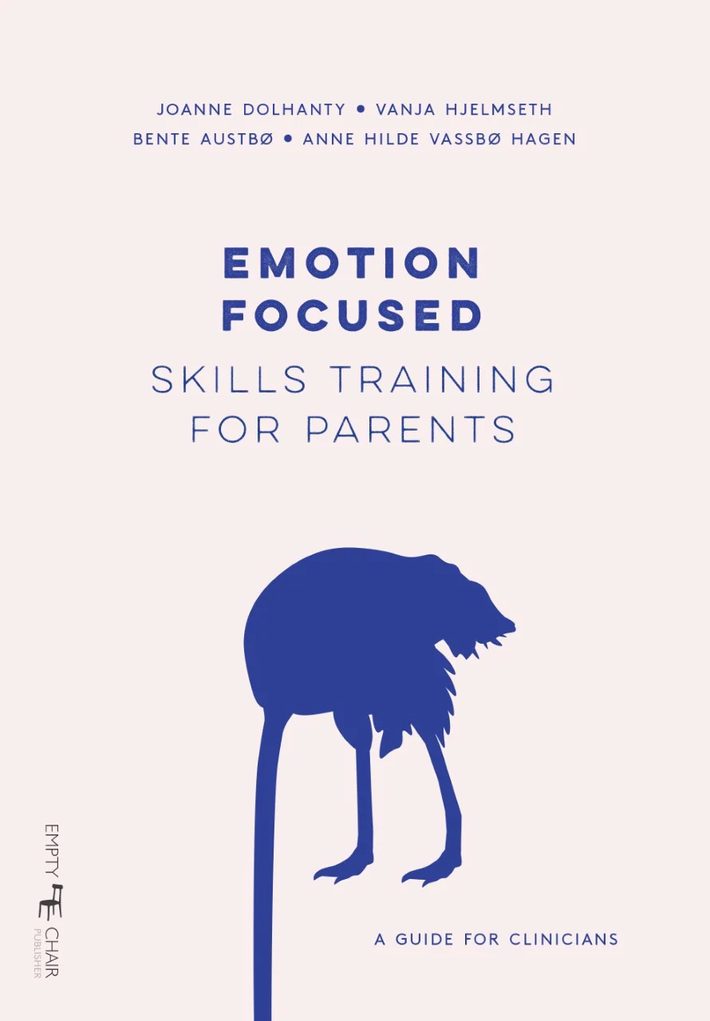
Dr. Joanne Dolhanty, Vanja Hjelmseth, Bente Austbø & Anne Hilde Vassbø Hagen
$59.99 USD
This book gives a complete overview of the theory, practice, and research of an emotion-centered, humanistic approach to supporting the parents of individuals who struggle with any mental health challenge. The book conveys an unyielding belief in parents’ motivation and ability to heal the parent-child relationship and help their child (young, adolescent, or adult child) through their struggles. Drawing on the most current understanding of emotions and human development, the book clearly outlines a central role for parents in treating and preventing mental health difficulties in their families. The many examples provide a vivid and emotionally moving portrait of the power of parents if we only support them to find their way.
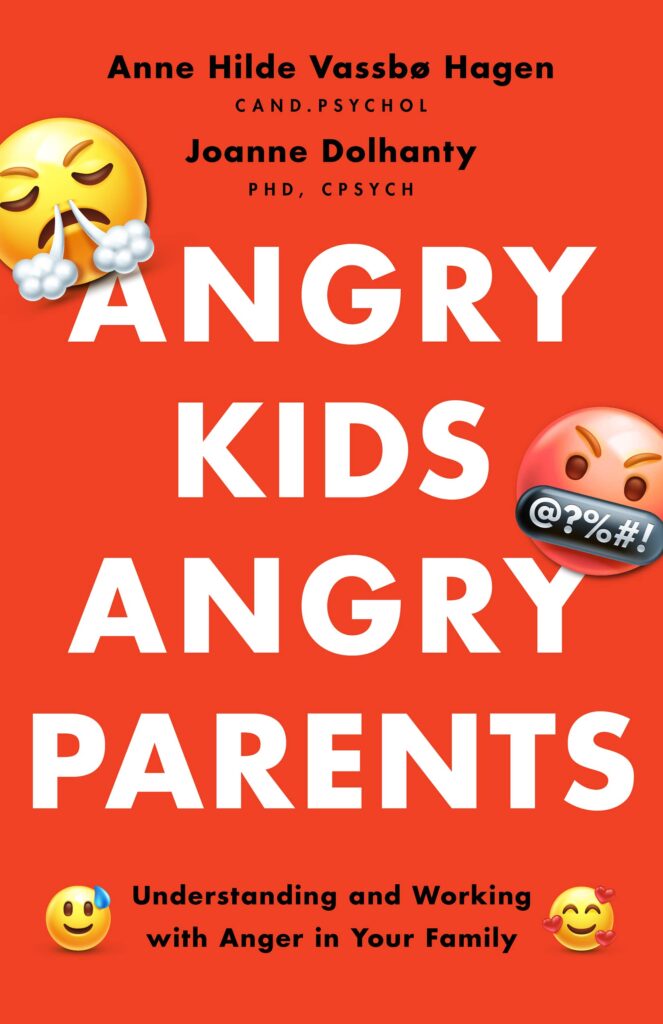
Anne Hilde Vassbø Hagen, cand.psychol, and Joanne Dolhanty, PhD
$21.99 USD
Psychologists Anne Hilde Vassbø Hagen and Joanne Dolhanty explain everything you need to know about your child’s anger and how to manage it.
Anger can be normal and healthy when it enables us to stand up for ourselves and defend against injustice. However, it can also lead to aggression—even violence—while also hiding other, more vulnerable emotions. For instance, an angry child may be hiding embarrassment, shame, disappointment, sadness, loneliness, or fear. As a parent, it is your job to help your child understand their anger, express it in an appropriate way, and address the underlying need.
In Angry Kids, Angry Parents you will learn how to respond to your child’s anger in a sensitive and productive way that validates their feelings, addresses their needs, and teaches them to manage their own anger. It can be nerve-wracking to watch your child explode in rage. This book will teach you how to stay calm and protect your boundaries.
Supported by years of psychological research and therapeutic practice, the strategies in this practical, compassionate book will help any parent who struggles with their child’s anger.
* Use Promo Code APA25 to save 25% and enjoy free domestic shipping.
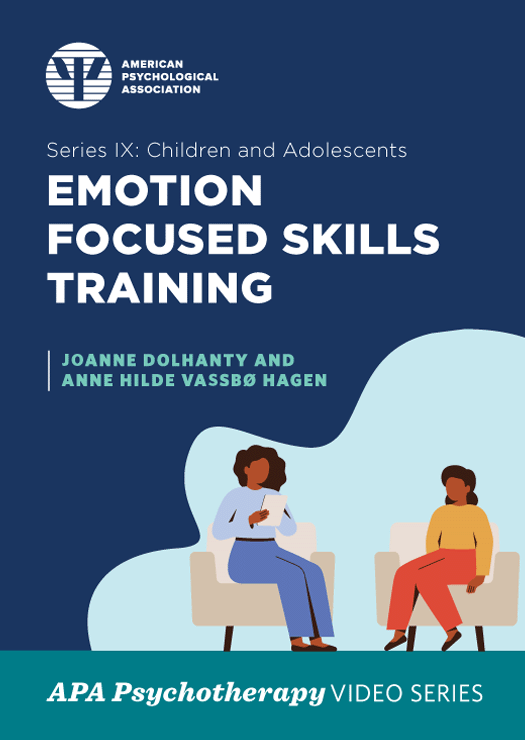
Joanne Dolhanty and Anne Hilde Vassbø Hagen
Part of Series IX: Children and Adolescents
You can now purchase this video where Joanne and Anne Hilde take you through an EFST session with a parent and explain as they go.
A film for all parents who have angry kids or are angry themselves.
Meet a father in the middle of a challenging bedtime routine, where Lego bricks are flying, and he grabs his eldest daughter hard by the arm. How will he manage to fix things once they’ve gone wrong, and how will he get the kids to the bathroom to brush their teeth? Want to learn more about anger?
Read the book with the same title, “Angry Kids, Angry Parents” by Anne Hilde Vassbø Hagen and Joanne Dolhanty.
Anger helps us stand up for ourselves, set boundaries, and protect ourselves from threats and injustice. But anger can also show up as rejecting rage, screaming, biting, hitting, and kicking. Anger and aggression in children cause great concern for parents, and there is a high demand for knowledge and advice. What is anger? Why is this emotion so challenging? What does a child who is threatening and has a dark look in their eyes need? How can even the most discouraged parents regain confidence that they can manage their child’s anger?
The key lies in understanding how anger works and that there are often vulnerable emotions behind aggressive behavior. A raging child is often embarrassed or ashamed, and anger can be an expression of grief, loneliness, or fear. Adults need to become aware of what feelings the child’s intense behavior triggers in themselves, and how they can work with their own emotions that may hinder them from being there for the child in a good way without becoming aggressive in return. Anger is an emotion with a bad reputation. We also want to remind people why anger is an important feeling. Having a healthy relationship with anger can prevent mental health issues.
This film is made in Norwegian by Anne Hilde Vassbø Hagen, and translation and therapist voice in this English film is done by Dr. Joanne Dolhanty.
The film is made in collaboration with Rådet for psykisk helse, and financed by Stiftelsen Dam.
Want to learn more? Read the book Angry Kids, Angry Parents
This video presents the paper, Emotion-focused skills training for parents with anxious children. A pilot study. Published online in Journal of Marital and Family Therapy in April 2023
Emotion Focused Podcast with
Dr. Lou Cooper
‘Yummy foods and starvation are like taking a good strong dose of pain medicine.’ Joanne Dolhanty talks about an emotion focused perspective to understanding eating disorders.
Emotion Focused Podcast with
Dr. Lou Cooper
Are you emotionally a lion or a lamb? And how can you best use your characteristic way of being as a parent? Joanne Dolhanty describes an Emotion Focused approach to parenting.
Emotion-focused skills training for parents – a narrative review.
Person-Centered & Experiential Psychotherapies. Ansar, N., (2024)
This paper provides an overview of EFST research, including a key effectiveness trial examining child and parent mental health and functioning outcomes, alongside findings from related emotion-focused parent interventions, such as Emotion Focused Family Therapy (EFFT).
Journal of Clinical Child & Adolescent Psychology, 51(6), 923-939. Ansar, N., Nissen Lie, H., Zahl-Olsen, R., Bertelsen, B. T., Elliott, R., & Stiegler, J.R. (2022).
This study shows that children’s mental health symptoms can be significantly reduced with ESFT. Children of both groups of parents showed significant symptom reductions that were maintained over 12 months. After accounting for higher dropout rates in the psychoeducational group, the experiential group was associated with stronger treatment effects.
Psychotherapy Research. Ansar, N.; Nissen Lie, H.; Stiegler, J.R. (2023).
In this study EFST resulted in significant improvements in caregivers’: (a) mental health, (b) parental self-efficacy, and (c) emotion regulation. Parents in the experiential condition produced greater improvements in a and b. Fathers appeared to benefit more than mothers in b and c; however, mothers comprised most of the sample. The study found a reciprocal relationship between parent and child well-being, with the strongest effects suggesting that improvements in children’s mental health led to improvements in parental well-being.
Frontiers in Psychology, 12:559188. Ansar, N., Hjeltnes, A., Stige, S.H., Binder, P-E., & Stiegler, J.R. (2021).
This qualitative study examined the experiences of 14 parents who participated in the experiential EFST condition. Three themes emerged: Coming Home, in which parents described greater acceptance of their own and their children’s emotions and a stronger sense of inner security; Reclaiming Parenthood, in which parents developed confidence and agency by applying and adapting EFST skills in daily life; and This Is Us in which parents reported generalizing their learning to other family relationships, leading to positive changes in family dynamics. The findings also underscored the importance of therapist characteristics (e.g., sensitivity, openness to feedback, etc).
Ansar, N., Stige, S.H., Pedersen Engeset, S.M., Nilsen, B., Schanche, E. (2025)
This qualitative study explored men’s subjective experiences of participating in EFST through interviews with five fathers from the experiential condition, all of whom had sons. Five themes emerged: (1) an initial surprise at being asked to explore their own emotional patterns, (2) a sense of community fostered by the group experience, (3) strengthened connection and security within their partner relationship, (4) greater insight into their own emotional and behavioural patterns, and (5) experiencing fatherhood in new ways through the practical application of EFST skills and tools.
Emotion-focused skills training for parents with anxious children. A pilot study.
Journal of Marital & Family Therapy, 22(1). Zahl-Olsen, R., Severinsen, L., Shahar, B., Stiegler, J.R., & Bertelsen , T.B. (2023).
In this pilot study of nine children (ages 8–14) with anxiety disorders, EFST was associated with substantial reductions in anxiety. Following a two-day parent workshop and five weekly individual EFST sessions, two-thirds of the children achieved remission from their primary diagnosis and one-third no longer met criteria for any anxiety disorder. Results support EFST as a promising parent-focused intervention that helps children by teaching parents to validate fear and regulate it.
BMC Psychiatry, 22(1). Severinsen, L., Stiegler, J.R., Nissen-Lie, H.A., Shahar, B., & Zahl-Olsen, R. (2022).
This paper outlines the protocol for a randomized controlled trial designed to compare the effectiveness of EFST with treatment-as-usual (a family-based intervention) in an outpatient mental health clinic serving children ( 6–18 years old). It describes the study rationale, design, intervention, outcome measures, and planned analyses. Although no outcomes are presented, the study lays the groundwork for a rigorous evaluation of EFST – helping to advance research on the effectiveness of the intervention in real-world clinical settings.
Emotionsfokussiertes Skilltraining für Eltern und Familien (EFST)
Ein innovativer Ansatz für die Begleitung von Eltern (nicht nur) psychisch kranker Kinder: Dr. Julika Swack and Dr. Joanne Dolhanty